Introduction
The flying chess board is more than just a colorful game surface — it’s the heart of one of the most entertaining strategy-based board games enjoyed by players of all ages. At first glance, it may look similar to classic race games like Ludo, but once the game starts, the flying routes, shortcut mechanics, and competitive gameplay make it feel completely different.
In recent years, Flying Chess has become increasingly popular in both physical and mobile gaming formats. Whether people are playing with friends at home or joining multiplayer matches online, the flying chess board remains the center of the entire experience.
Understanding the layout, movement paths, safe zones, and flying mechanics is important if you want to enjoy the game properly. This guide explains everything clearly, from the structure of the board to gameplay strategy, design types, and modern digital versions.
If you want a complete understanding of the flying chess board, this article covers everything in a practical and beginner-friendly way.
What is a Flying Chess Board?
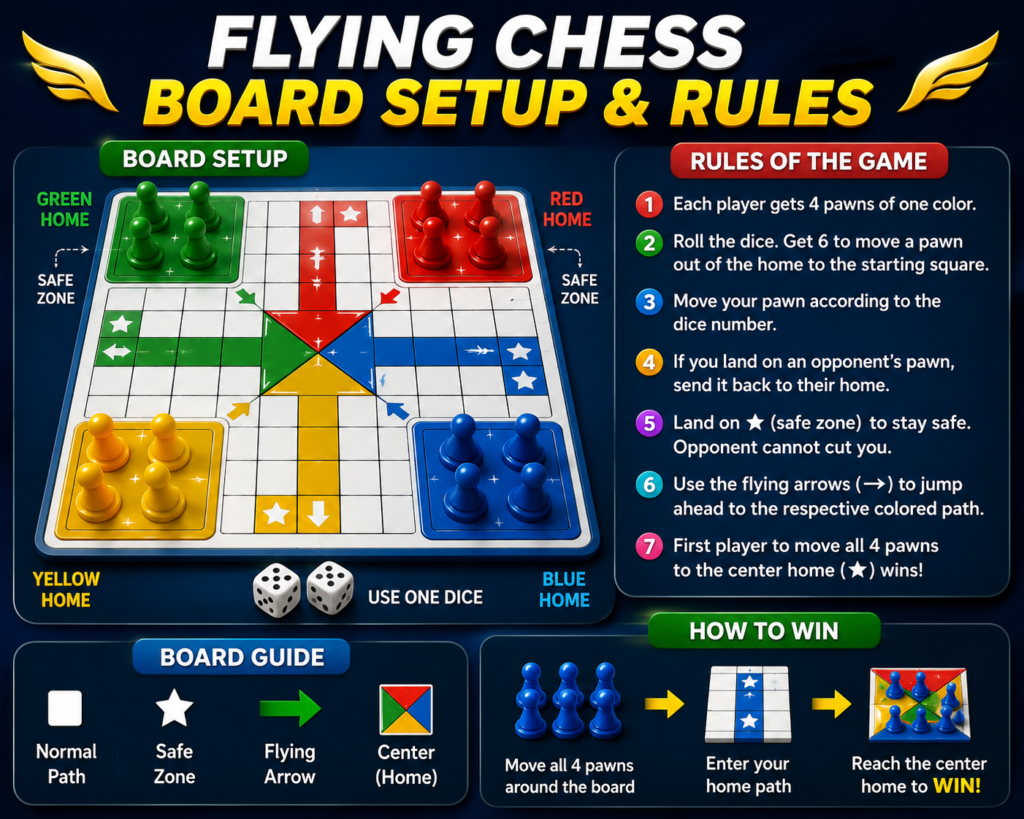
A flying chess board is the playing surface used in the Flying Chess game. It contains colored paths, player bases, movement tracks, flying shortcut zones, and home areas where players must guide their pieces to win.
Most boards support 2 to 4 players. Every player gets a color section with four pieces placed inside a starting base. The board then connects all player routes through a circular movement track leading toward the center home area.
What makes the flying chess board unique is the addition of flying routes. These special jump paths allow pieces to move faster across the board, creating more exciting and unpredictable gameplay.
Unlike traditional board games that depend only on slow movement, Flying Chess feels more dynamic because the board itself creates opportunities for sudden progress.
Structure of a Flying Chess Board
The design of the flying chess board is carefully built to balance luck and strategy.
The board usually contains:
- Four colored bases
- Circular movement tracks
- Safe zones
- Flying shortcut points
- Final home paths
- Central winning area
Each section has a specific role in gameplay.
The colored bases hold the player pieces before they enter the game. The movement track guides players around the board, while flying routes create faster movement opportunities.
Safe zones protect pieces from being captured, which adds a defensive layer to the game.
How the Flying Chess Board Works During Gameplay
The board controls the entire flow of the game.
Players roll a dice and move their pieces clockwise along the movement path. A roll of six usually allows a piece to leave the base and enter the board.
As pieces travel around the board, players aim to:
- avoid being captured
- use flying shortcuts
- reach safe zones
- move toward the center home area
The flying chess board creates constant tension because every position matters.
One piece may look safe one moment and become vulnerable the next depending on opponent movement.
Flying Routes: The Most Important Part of the Board
The biggest reason the flying chess board feels different from regular race games is the flying system.
Certain colored points on the board act as launch positions. When a player lands there, the piece can instantly jump ahead across the track.
This creates dramatic momentum changes during matches.
A player who seems behind can suddenly move far ahead because of a lucky flying route.
Experienced players often build their entire strategy around these shortcuts because they reduce travel time significantly.
Without the flying system, the game would feel much slower and less exciting.
Safe Zones on a Flying Chess Board
Safe zones are another important element of the board design.
These are protected spaces where opponent pieces cannot capture you. In many versions, safe zones are marked using stars, circles, or highlighted colors.
Safe zones create balance in the game because they prevent players from losing progress too easily.
They also introduce decision-making:
Should you stop safely or move aggressively forward?
This small choice often changes the outcome of a match.
Understanding the Board Layout as a Beginner
For beginners, the flying chess board may look complicated at first because of the multiple colors and paths.
But once you understand the layout, it becomes very simple.
Each player follows their own colored entry path before joining the shared movement track. After completing one full round around the board, the piece enters its final home path leading to the center.
The flying routes are usually placed strategically to speed up movement between sections.
The more you play, the more natural the board layout feels.
Types of Flying Chess Boards
Over time, different styles of flying chess boards have become popular.
Some boards are physical, while others exist digitally inside mobile apps and online games.
Here’s a simple comparison:
| Board Type | Features | Best For |
|---|---|---|
| Physical Board | Traditional gameplay with real pieces | Family & friends |
| Foldable Travel Board | Portable and lightweight | Travel gaming |
| Digital Mobile Board | Online multiplayer and fast gameplay | Smartphone users |
| 3D Animated Board | Visual effects and interactive movement | Modern gaming experience |
Each version offers a different experience, but the core gameplay remains similar.
Physical Flying Chess Board vs Digital Version
The physical flying chess board gives a classic tabletop experience. Players roll real dice, move physical pieces, and interact face-to-face.
Digital versions, however, add animations, online matchmaking, rankings, and faster gameplay.
Many players now prefer mobile versions because they can play anytime without needing a physical board setup.
Still, traditional boards remain popular because they create a more social and personal gaming experience.
Both versions continue to grow in popularity for different reasons.
Materials Used in Modern Flying Chess Boards
Modern flying chess boards are made using different materials depending on quality and price.
Common materials include:
- cardboard
- laminated paper
- plastic
- wooden surfaces
- digital touchscreen interfaces
Premium boards sometimes use magnetic pieces and foldable travel designs for convenience.
Digital boards inside apps often use animated effects and colorful visuals to make gameplay more engaging.
Why the Flying Chess Board Design Matters
The design of the board directly affects gameplay quality.
A well-designed flying chess board makes movement easy to understand and helps players identify safe zones, flying points, and home paths quickly.
Badly designed boards create confusion and slow the game down.
Modern versions focus heavily on:
- bright visuals
- easy navigation
- clear movement paths
- balanced spacing
This improves the overall player experience.
Strategy Based on Board Positioning
Winning Flying Chess is not only about luck. Positioning on the board matters a lot.
Strong players always pay attention to:
- nearby opponent positions
- safe zones
- flying opportunities
- risky areas
Sometimes staying safe is smarter than moving aggressively.
The flying chess board constantly forces players to balance speed and safety.
That’s one reason why the game stays interesting even after many matches.
Common Mistakes Players Make on the Board
Many beginners misuse the board layout because they rush without understanding positioning.
One common mistake is ignoring safe zones completely. Another is missing flying opportunities because players focus only on normal movement.
Some players also keep all pieces grouped together, which increases the risk of losing multiple positions at once.
Understanding the board properly helps avoid these mistakes.
Flying Chess Boards in Mobile Gaming
In 2026, mobile gaming versions of Flying Chess are more popular than ever.
Modern apps use advanced flying chess board designs with:
- animated dice
- smooth movement effects
- online multiplayer systems
- voice chat features
- ranked gameplay
These digital boards make matches feel faster and more competitive.
The overall design is built to keep players engaged for longer periods.
Why Flying Chess Continues to Stay Popular
The flying chess board remains popular because it combines simplicity with excitement.
The rules are easy enough for beginners, but the board design creates enough strategy to keep experienced players interested.
Every match feels different because:
- dice outcomes change constantly
- flying routes create surprises
- player interactions stay unpredictable
This balance keeps the game fresh.
Conclusion
The flying chess board is the foundation of one of the most entertaining strategy board games still popular in 2026. Its unique combination of movement tracks, flying shortcuts, safe zones, and competitive gameplay creates an experience that feels both simple and exciting.
Whether you play on a traditional physical board or through a modern mobile app, understanding the board layout improves your gameplay immediately. Once you learn how movement, positioning, and flying routes work together, the game becomes far more enjoyable and strategic.
Flying Chess continues to grow because the board itself creates endless moments of surprise, tension, and fun — making every match feel different from the last.
FAQs
1. What is a flying chess board?
A flying chess board is the playing surface used in the Flying Chess game, featuring movement tracks, flying shortcuts, safe zones, and home areas.
2. How many players can use a flying chess board?
Most flying chess boards support 2 to 4 players.
3. What are flying routes on the board?
Flying routes are shortcut paths that allow pieces to jump ahead quickly.
4. Are digital flying chess boards different from physical ones?
The gameplay is mostly the same, but digital boards include animations, multiplayer systems, and faster gameplay.
5. Why are safe zones important on a flying chess board?
Safe zones protect player pieces from being captured by opponents.