Introduction
Flying Chess is one of those board games that looks simple at first, but once you start playing, you realize there’s more thinking involved than expected. It’s fast, a bit unpredictable, and honestly quite fun because every dice roll can completely change the game.
If you want to understand flying chess rules properly, you don’t need complicated explanations. You just need a clear idea of how movement works, when you can capture pieces, and how the flying shortcuts actually help you win faster.
This guide explains everything in a natural, easy way so you can actually play without confusion.
What Flying Chess Is ?
Flying Chess is basically a race game. Each player has four pieces, and the goal is simple: move all of them from your starting base to the center home area before everyone else.
But unlike normal board games, you don’t just move step by step. You also get special “flying” shortcuts that let you jump ahead, which makes the game faster and more exciting.
It’s a mix of luck (dice) and smart decisions (when and where to move).
Basic Flying Chess Rules
Let’s break it down in the simplest way possible.
At the start, all your pieces stay inside your base. You can’t move them out unless you roll a 6. Once you get a 6, you can bring one piece onto the board.
After that, every turn you roll the dice and move forward based on the number you get.
The direction is always clockwise around the board.
If you land on a space where an opponent is standing, their piece goes back to the base — unless that space is a safe zone.
That’s the core of the flying chess rules.
How Movement Works
Movement is very straightforward:
- Roll the dice
- Move that number of steps
- Continue around the board in a circle
But the real decision is not just how far you move — it’s where you stop.
Sometimes moving one piece forward is safe. Sometimes it puts you in danger. That’s where the strategy starts.
You also need an exact number to enter the home area. If you go over, you can’t move in.
Flying Feature (The Special Part)
This is what makes Flying Chess different from normal board games.
Certain spots on the board act like “launch points.” If you land on them, your piece can jump forward to a much farther position instead of moving step by step.
It feels like a shortcut, and it can completely change the match in one move.
Sometimes a player who is behind suddenly gets ahead just because of a flying jump.
That’s why experienced players always keep an eye on these spots.
Capturing Opponents
One of the most exciting parts of the game is capturing.
If your piece lands exactly on an opponent’s piece, that opponent has to send their piece back to the starting base.
This creates constant tension in the game because nobody feels safe for long.
But there’s a twist: if a piece is on a safe zone, it cannot be captured.
So players often stop there to protect themselves.
Winning the Game
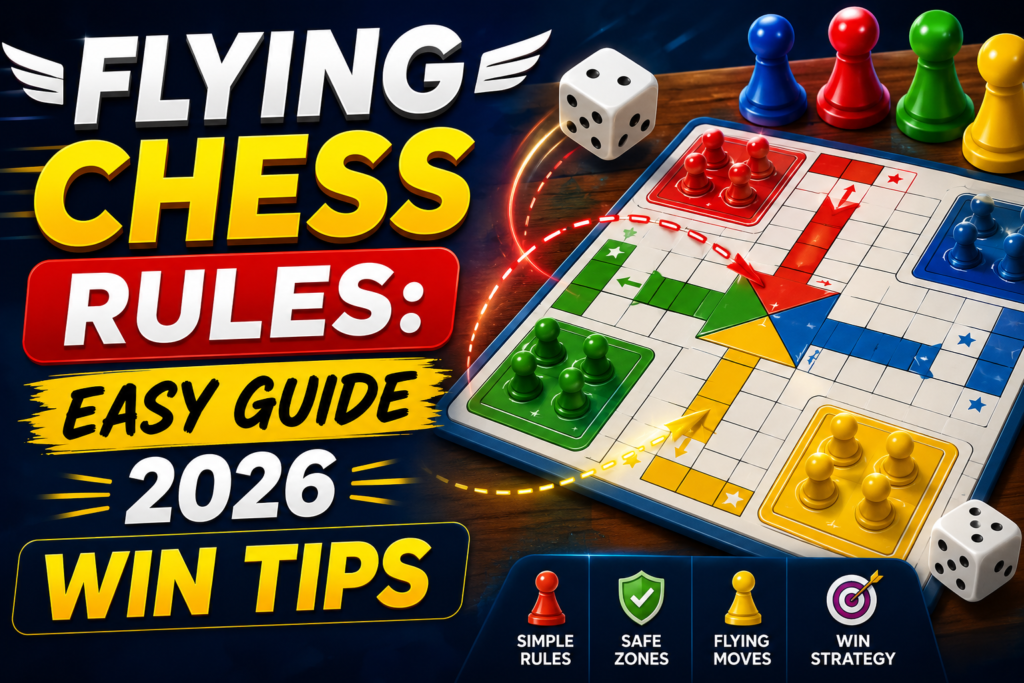
To win Flying Chess, you need to bring all four of your pieces into the center home area.
But there’s an important rule: you must roll the exact number needed to enter home. If your roll is higher, you cannot move in.
This often creates intense final moments where players are stuck waiting for the perfect roll while others are closing in.
The first player to finish all four pieces wins.
Quick Rule Table
| Rule | Meaning |
|---|---|
| Start Rule | Roll a 6 to bring piece out |
| Movement | Move clockwise based on dice |
| Capture | Land on opponent = send back |
| Safe Zone | No capture allowed |
| Flying Move | Special jump shortcut |
| Win Condition | All 4 pieces reach home |
How a Typical Game Feels
At the beginning, the game feels slow because everyone is waiting for a 6.
Once pieces start entering the board, things get interesting. Players start capturing each other, blocking movement, and looking for flying shortcuts.
Mid-game is all about balance — staying safe while trying to move forward quickly.
End game is where pressure builds. One wrong move can send you back, and one good roll can bring you close to winning.
Common Mistakes Players Make
Most beginners make a few simple mistakes:
- Moving all pieces without thinking about safety
- Ignoring flying shortcuts completely
- Not saving pieces in safe zones
- Getting frustrated in the end game because of exact roll rules
Avoiding these mistakes instantly improves your gameplay.
Simple Winning Tips
- Don’t rush all pieces at once
- Use flying shortcuts whenever possible
- Keep at least one piece safe when needed
- Watch opponent positions before moving
- Be patient in the final stage
These small habits make a big difference.
Conclusion
Flying Chess is not just about luck — it’s about timing, awareness, and small smart decisions. Once you understand the flying chess rules, the game becomes much more enjoyable and competitive.
It’s simple to learn, but every match feels different, which is why people keep playing it again and again.
In the end, the winner is usually not just lucky — but the one who plays a bit smarter with every move.
FAQs
1. How do you start Flying Chess?
You need to roll a 6 to bring a piece onto the board.
2. What happens when you land on an opponent?
Their piece goes back to the base.
3. What is flying in Flying Chess?
It’s a shortcut that lets your piece jump ahead.
4. Can pieces be safe from capture?
Yes, safe zones protect pieces from being captured.
5. How do you win Flying Chess?
By moving all four pieces into the home area first.